

New indicators showcase VeriXiv’s rigorous verification checks, setting new standards for preprint integrity
Open research publisher F1000 has announced that its preprint server, VeriXiv, has introduced trust marker badges to provide clear confirmation of the extensive verification checks each preprint undergoes before being made available on the site. This enhancement makes VeriXiv the first major preprint platform to display comprehensive research integrity verification to readers.
Launched in August 2024, in collaboration with the Gates Foundation, VeriXiv provides a solution that combines the speed of preprints with the quality assurance the research community requires. Before being made available on the platform, each submitted preprint is subject to rigorous screening across four key categories: authorship verification, publishing ethics, research integrity, and open research standards.
The new trust marker badges ensure readers can easily see which of these verification checks each preprint has completed and passed. Details about the scope of each verification check are available on the VeriXiv website.
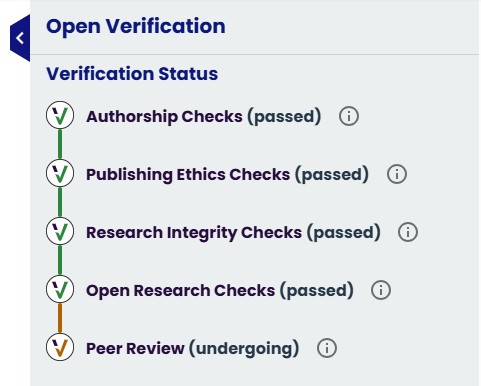
Preprints are research papers shared before peer review. While their use has grown significantly in recent years, preprint servers typically conduct only minimal screening, raising concerns about the dissemination of research that has not been sufficiently checked for integrity issues such as conflicts of interest, image manipulation, plagiarism, or undeclared AI use.
VeriXiv addresses these concerns through a comprehensive verification process conducted by F1000’s specialist editorial teams. This approach identifies problematic preprints before they enter the scholarly record, ensuring VeriXiv preprints meet rigorous research integrity and publication ethics standards.
James Cleaver, Head of Publishing at F1000, said:
“As concerns about the risks to the integrity of preprints continue to grow, especially in an era of AI-generated content, transparency and trust have never been more critical. Many preprint servers are now finding that their current level of checks are not enough to hold back a flood of Al-generated submissions and that trying to deal with problematic preprints only after publication is often too late. These trust marker badges make our investment in extensive pre-publication verification workflows visible to everyone, giving researchers, funders, and policymakers confidence in the work they are reading.”
In addition to verification badges, VeriXiv also displays the peer review status of each preprint. Authors can choose to submit their preprint to Gates Open Research, in which case it undergoes transparent, post-publication peer review on VeriXiv. Once the preprint passes peer review, the final version of record is published on Gates Open Research.
This development comes after The National Information Standards Organization (NISO) recently approved a Trust Markers Working Group, to establish a Recommended Practice that will provide a framework for understanding items that signal trust in published scholarly content. Taylor & Francis’ Vice President of Knowledge Translation, Dr Rebecca Lawrence, is one of the Co-Chairs of the Working Group.
About F1000
F1000 provides innovative open access publishing platforms offering rapid publication and open peer review, whilst supporting data deposition and sharing for the research community.
F1000’s own publishing platform, F1000Research, was launched in 2013 and was the first open research publishing platform combining the ability to publish rapidly with functionality to ensure transparency, robustness and reproducibility of research.
Building upon the growth and success of its core platform, F1000 also provides fully managed, open research publishing services directly to research funders, learned societies and institutions, including Wellcome, the Gates Foundation and the European Commission.
F1000 Research Ltd is wholly owned by Taylor & Francis, an Informa Group company.
Media contact
Mark Robinson, mark.robinson@tandf.co.uk